
Strabismus and laser vision correction – are they mutually exclusive? |
| 30.05.2026 |
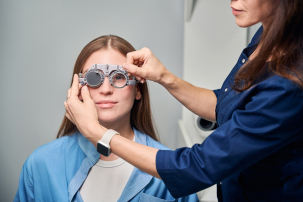 Strabismus is a misalignment of the eyes caused by impaired function of the eye muscles. In this condition, one eye focuses directly on the observed object, while the other deviates in a different direction. This issue can affect both children and adults.
Many patients wonder whether strabismus is a contraindication to laser vision correction. The answer is not entirely straightforward. Strabismus itself does not automatically rule out the procedure; however, each case requires thorough diagnostics and a detailed assessment of visual function.
Strabismus may develop as a result of an uncorrected refractive error, reduced vision in one eye, or eye conditions such as cataracts. It can also be associated with amblyopia, a condition in which one eye does not achieve normal visual acuity.
The most common types include:
It is important to emphasise that laser vision correction does not treat strabismus itself. The procedure corrects refractive errors such as myopia, hyperopia, or astigmatism, but it does not affect the muscles responsible for eye alignment. This means that if strabismus was present before the procedure, it may still remain afterwards.
Strabismus is considered a relative contraindication to laser vision correction. This means that the procedure may be possible, but only in selected individual cases. Every patient should undergo a detailed examination, including an assessment of binocular vision and an analysis of how the eyes function without glasses or contact lenses. Particular attention should be paid to ruling out double vision (diplopia), as this is an absolute contraindication to laser vision correction.
In some patients, strabismus is not noticeable while wearing corrective glasses. However, this does not necessarily mean that eye alignment will remain unchanged after the procedure. An important role may be played by the optical centre of the lens, which helps maintain proper eye positioning.
Following laser vision correction, the patient no longer wears glasses, meaning the eye loses the support previously provided by the optical centre of the lens. As a result, strabismus that had previously been controlled by glasses may become more noticeable.
During the pre-operative assessment, the ophthalmic surgeon may recommend undergoing strabismus surgery before laser vision correction. In such cases, an appropriate interval between the two procedures is essential.
It is generally recommended that at least six months should pass between strabismus surgery and laser vision correction. This allows sufficient time for eye alignment to stabilise and enables an accurate assessment during qualification for laser vision correction.
ArtLife Centrum Okulistyczne
80-398 Gdańsk
ul. Obrońców Wybrzeża 23
Centrum Horyzont
Telefon:
+48 58 557 57 77
+48 605 03 66 30
+48 506 807 111
E-mail:
info@artlife.com.pl
Poniedziałek - Czwartek
9.00 - 17.00
Piątek
9.00 - 16.00

Ta witryna używa pliki cookie. Korzystając ze strony wyrażasz zgodę na używanie plików cookie
zgodnie z aktualnymi ustawieniami przeglądarki. Możesz je w każdej chwili zmienić.
Aby dowiedzieć się więcej o plikach cookies lub je usunąć zapoznaj się z
zasadami wykorzystania plików cookies.
© 2015
- 2026 ArtLife Centrum Okulistyczne. Laserowa korekcja wzroku. Gdańsk, Sopot, Gdynia, Trójmiasto, Polska.
Design:
MK-Advice & ArtLife
